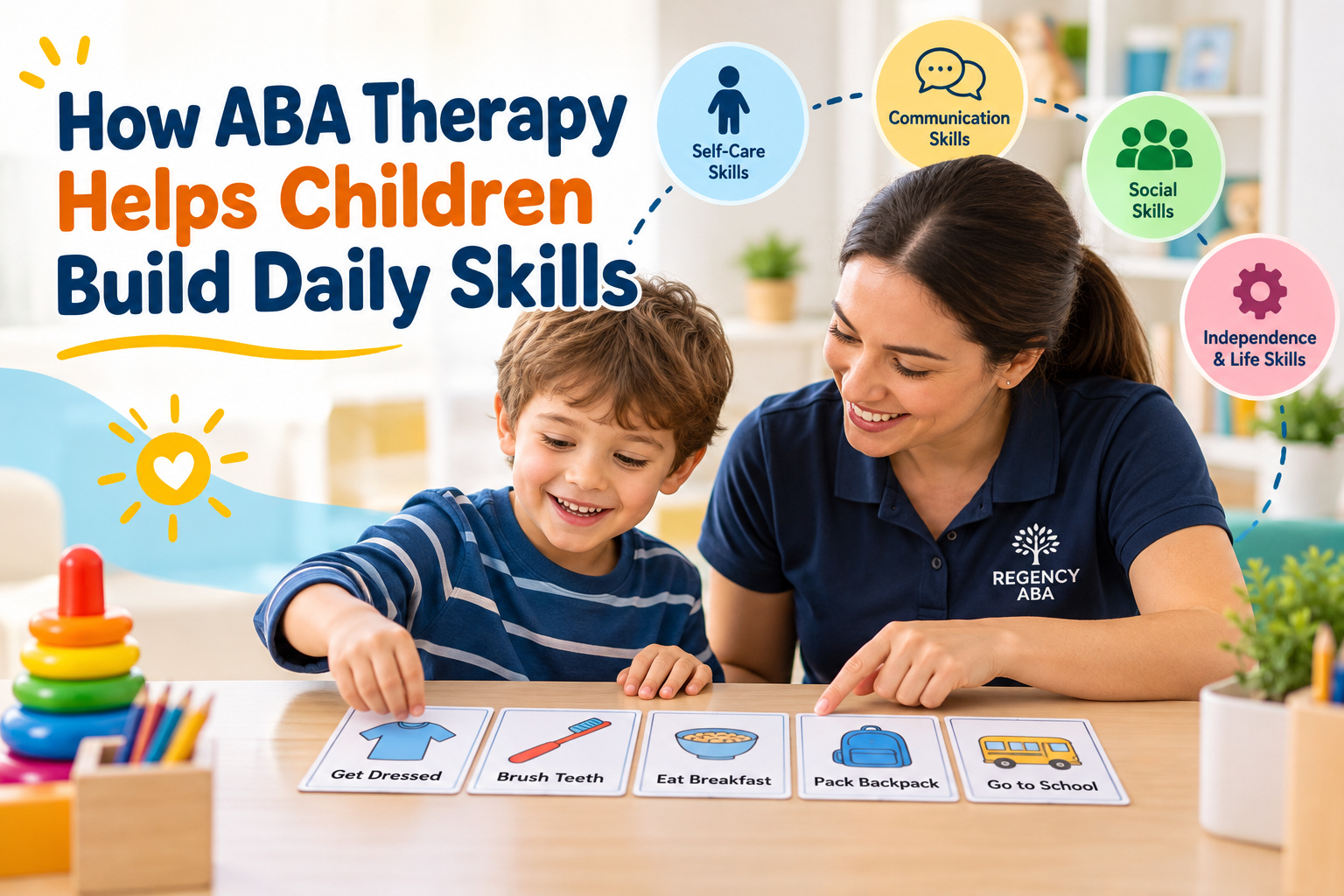
How ABA Therapy Helps Children Build Daily Skills
ABA therapy can help children develop communication, self-care, play, and everyday independence through individualized, practical learning. For families exploring support at Regency ABA Therapy in Georgia, understanding how Applied Behavior Analysis works can make it easier to choose an approach that respects a child’s needs, strengths, preferences, and pace of development.
TL;DR ABA therapy helps children practice useful daily skills by breaking activities into manageable steps, providing clear instructions, and using positive reinforcement when appropriate. These skills may include communicating needs, getting dressed, brushing teeth, following routines, playing with others, and completing simple household tasks. Applied Behavior Analysis (ABA) is commonly used to support children with autism, although its suitability and goals should be assessed individually. Effective programs focus on meaningful outcomes, not simply compliance. Therapists can work with families to identify priorities, measure progress, and help children use new skills in different settings, such as home, school, and the community. Parents should look for qualified professionals who involve caregivers, respect communication differences, accommodate sensory needs, and adapt treatment to the child’s progress. The aim is to make everyday life more accessible and build practical skills that improve participation, confidence, and independence.
Children learn everyday skills at different rates. A task that seems simple to an adult, such as asking for help, putting on shoes, or following a morning routine, may involve several separate abilities for a child who needs additional support. When these tasks become frustrating, families may struggle to find teaching methods that work consistently.
Quick Answer ABA therapy helps children build daily skills by teaching practical tasks in small, achievable steps and practicing them in meaningful situations. Individualized goals, positive reinforcement, caregiver involvement, and regular progress reviews can help children apply what they learn to everyday life. The program should be adapted to each child’s abilities, preferences, communication style, and comfort.
What is ABA Therapy for Children?
ABA therapy for children is an individualized approach based on Applied Behavior Analysis, a field that studies how learning and the environment influence behavior. It uses observation, practice, and reinforcement to help children develop useful skills, including communication, social interaction, self-care, and participation in daily routines.
ABA providers may teach a skill through structured activities, natural play, or everyday tasks. The approach should be tailored to the child’s developmental level, communication needs, interests, and family priorities. Progress is monitored so the team can adjust teaching methods when needed.
How ABA Therapy Helps Children Develop Everyday Skills
ABA therapy connects learning with activities children encounter throughout the day. Instead of treating a daily task as one large challenge, a therapist identifies the smaller abilities needed to complete it.
For example, getting ready for school may involve choosing clothes, putting on a shirt, finding shoes, packing a bag, and transitioning to the next activity. A child may already perform some steps independently and need support with others.
An individualized program can focus on those specific needs.
1. Building Communication Skills
Communication helps children express their needs, share interests, make choices, and connect with other people. Some children communicate through speech, while others use gestures, picture cards, sign language, or augmentative and alternative communication (AAC) devices.
ABA-based teaching can help children practice functional communication in situations that matter to them.
Examples include:
- Asking for help when a task feels difficult.
- Requesting a preferred toy, activity, or break.
- Answering familiar questions when comfortable.
- Expressing discomfort or saying no.
- Taking turns during conversations or play.
- Communicating when they need more time or a change in activity.
A therapist might create a natural opportunity for a child to request a favorite activity. The child can communicate using their preferred method, and the therapist responds appropriately.
The objective is not to require speech when another communication method works better. It is to help the child communicate effectively and have their needs understood.
2. Improving Personal Care and Hygiene
Self-care skills can make daily routines easier for children and their caregivers. However, activities such as brushing teeth, washing hands, bathing, and dressing may involve motor planning, sensory processing, sequencing, and communication.
A therapist can break a task into smaller steps and teach them gradually.
Consider handwashing:
- Turn on the tap.
- Wet the hands.
- Apply soap.
- Rub the hands together.
- Rinse away the soap.
- Turn off the tap and dry the hands.
A child may complete most of these steps without help but need a visual reminder for the next step. Another child may need a different teaching method, more time, or an adaptation to the environment.
The therapist can adjust the level of assistance as the child gains confidence and skill. Sensory discomfort, such as dislike of water temperature or soap texture, should also be considered rather than treated simply as unwillingness.
3. Following Daily Routines
Predictable routines can help children understand what happens next and prepare for transitions. Visual schedules, first-then boards, timers, and simple instructions may make a routine easier to follow.
For instance, a bedtime routine might include putting toys away, changing clothes, brushing teeth, choosing a book, and settling into bed.
The therapist and family can identify which parts of the routine create difficulty. They can then introduce supports that fit the child’s needs.
Useful strategies may include:
- Showing a picture of each activity.
- Giving one clear instruction at a time.
- Offering choices when possible.
- Providing advance notice before a transition.
- Allowing enough time to finish an activity.
- Gradually reducing prompts when the child no longer needs them.
Consistency helps, but routines should remain flexible enough to accommodate illness, fatigue, changes in plans, and the child’s emotional state.
Key point: Daily living skills are easier to teach when adults focus on the specific step a child needs help with. Visual supports, appropriate prompts, and repeated practice can reduce frustration without demanding that every child follow an identical routine.
4. Strengthening Social Interaction and Play
Play offers opportunities to practice communication, cooperation, decision-making, and shared enjoyment. Some children may want help joining a game, understanding its rules, or expressing their preferences during group activities.
ABA therapy may support these goals through activities such as building with blocks, playing a simple board game, or completing a shared art project.
A child might practice asking another person to join, requesting a turn, responding to a suggestion, or negotiating which game to play.
Social goals should respect the child’s personality and boundaries. A child does not need to maintain eye contact, suppress harmless repetitive movements, or imitate every social convention to develop meaningful relationships.
The more useful goal is to help children communicate, participate, and build relationships in ways that feel comfortable and authentic to them.
5. Developing Independence at Home
Small household tasks can help children participate in family life. Depending on age and ability, these might include putting toys away, placing dirty clothes in a basket, carrying an unbreakable plate to the kitchen, or packing a school bag.
A therapist may teach a task using a process called task analysis. This means separating an activity into clear steps and determining which steps the child can already perform.
For example, packing a school bag might involve checking a visual list, finding the correct books, placing them inside, adding a lunch container, and checking the list again.
Parents can then provide opportunities to practice the same routine at home. The goal is to increase meaningful participation over time, not to expect immediate independence.
How ABA Therapy Teaches Daily Skills Step by Step
ABA therapy is most useful when teaching methods match the child’s needs and the goal is meaningful in everyday life.
Step 1: Identify a Practical Goal
The therapist and family discuss situations that matter to the child. A goal might be communicating a need for help, completing part of a morning routine, or participating more comfortably in family activities.
Goals should be specific enough to measure but flexible enough to accommodate the child’s changing needs.
Step 2: Assess Existing Skills
Before teaching a task, the therapist observes what the child can already do, what support is needed, and what might make the activity difficult.
A child who struggles with dressing may need help with fine motor movements, clothing choices, sensory comfort, or understanding the sequence. Each possibility calls for a different response.
Step 3: Break the Task Into Manageable Steps
The therapist identifies the individual actions needed to complete the activity. Teaching can begin with a step the child is ready to learn rather than requiring the whole task at once.
Some children benefit from learning the first step and gradually adding others. For different tasks, the therapist may teach the final step first so the child can experience completing an activity.
Step 4: Use Appropriate Prompts and Reinforcement
Prompts may include spoken instructions, pictures, gestures, demonstrations, or other assistance suited to the child.
Positive reinforcement means providing a meaningful response after a behavior, making that behavior more likely to occur again. This could involve praise the child enjoys, access to a chosen activity, or the natural benefit of completing a task.
Reinforcement should respect the child’s preferences and dignity. Food, comfort, communication, bathroom access, and other basic needs should not be withheld to make a child comply.
Step 5: Reduce Assistance Gradually
When a child begins completing a step successfully, the therapist can adjust the support provided. The aim is to help the child perform the task with less assistance when appropriate.
Progress may be gradual. Some skills require more practice than others, and children may need additional support during stressful or unfamiliar situations.
Step 6: Practice Across Different Settings
A child may learn to put on shoes in a therapy room but struggle when getting ready for school. Practicing in the actual environment can help bridge that gap.
This process is called generalization. It means using a learned skill with different people, materials, or settings rather than only under the conditions in which it was taught.
Step 7: Review Progress and Adjust
The therapist reviews observations and progress data with the family. If a strategy is not helping, the team should investigate why and adjust the approach.
Progress should be measured by meaningful improvements in the child’s life, including greater participation, more effective communication, reduced distress, and appropriate independence.
Key point: Effective skill development involves more than repetition. Assessment, individualized teaching, respectful reinforcement, and practice in everyday settings help children use their skills when they actually need them.
Choosing the Right ABA Therapy Setting in Georgia
The setting can influence how easily a child practices new skills. Families in Georgia may consider home-based, center-based, school-based, community-based, or virtual services, depending on the provider’s offerings and the child’s needs.
Regency ABA describes several service options on its website, including home-based, center-based, community-based, in-school, and virtual ABA services. The appropriate option depends on the child’s goals, clinical assessment, family circumstances, and service availability.
Home-Based ABA Therapy
Home-based sessions allow children to practice skills where they naturally occur. A therapist might work on getting dressed, following a morning routine, communicating during meals, or putting toys away.
Parents can observe teaching methods and learn how to support skills between sessions. The home environment may also reveal practical barriers that are difficult to identify in a clinic.
Center-Based ABA Therapy
A therapy center can offer a structured environment for individualized instruction, planned activities, and opportunities to practice certain social or learning skills.
This setting may suit goals that benefit from fewer distractions or access to specific learning materials. However, skills learned at a center should also be practiced in everyday environments when appropriate.
School-Based and Community-Based Support
School-based support may focus on classroom participation, transitions, communication, and completing age-appropriate activities. Community-based support can help children practice skills in places such as parks, shops, libraries, and recreational programs.
For example, a child might learn to follow a shopping list, communicate a preference, or ask a trusted adult for help during an outing.
Virtual ABA Services
Virtual sessions may support caregiver coaching, progress discussions, and selected teaching activities. Their suitability depends on the child’s goals, family resources, and ability to participate through telehealth.
Not every skill can be taught effectively online. Families should ask how the provider will assess progress and determine whether virtual support is appropriate.
How Parents Can Support Daily Skill Development at Home
Parents and caregivers play an important role because everyday routines provide many opportunities to practice. They do not need to turn the whole day into a therapy session.
Start with one activity that would make family life easier. If a child is learning to put away toys, for example, begin with a clear storage location and a simple visual cue. Allow time for the child to participate, and provide support when needed.
Other practical ideas include:
- Keep instructions clear. Use short, specific language rather than several directions at once.
- Offer meaningful choices. Let the child choose between suitable clothes, activities, or ways to complete a task.
- Follow the child’s communication. Respond to gestures, pictures, AAC, speech, and other ways the child expresses needs.
- Allow processing time. A child may need additional time to understand an instruction or prepare for a transition.
- Notice small improvements. Recognize genuine effort and progress without making every interaction a test.
- Coordinate with the therapy team. Ask which strategies are suitable for home and how to use them consistently.
- Adjust when something is not working. Fatigue, sensory discomfort, anxiety, and changes in routine can affect participation.
Parents should also feel comfortable raising concerns about a therapy method. A good provider welcomes questions and explains the purpose of each goal, the child’s response, and any proposed changes.
Understanding Evidence and Setting Realistic Expectations
Research supports some behavioral interventions for improving specific skills and reducing behaviors that interfere with everyday functioning. However, outcomes vary by child, intervention, goals, and circumstances. No single approach guarantees the same results for every family.
The U.S. Centers for Disease Control and Prevention describes ABA as one behavioral approach used in autism care and explains that progress is tracked and measured. The CDC also identifies other approaches, including speech and language therapy and occupational therapy, which may address related needs.
A randomized study of parent training for young children with autism and disruptive behavior found improvements in measured daily living skills compared with parent education alone. That finding supports the value of structured caregiver guidance, but it does not mean that every ABA program produces the same outcome.
Families should ask providers how they measure progress, how often goals are reviewed, and how treatment decisions reflect the child’s comfort and preferences.
A realistic plan recognizes that some skills develop quickly while others need ongoing support. Progress may also look different across settings. A child might complete a familiar routine independently at home but need reminders when tired or in a new environment.
The goal is steady, meaningful improvement rather than a fixed timetable.
Key point: Evidence should inform treatment, but individual results matter most. Families should expect clear goals, regular reviews, honest communication about progress, and adjustments when a strategy is ineffective or causes distress.
What Parents Often Ask About ABA Therapy for Daily Skills
What Most People Misunderstand
One common misunderstanding is that ABA therapy focuses only on reducing challenging behavior. Well-designed programs can also teach communication, self-care, play, safety awareness, and participation in daily routines.
Another misconception is that every child should work toward the same definition of independence. Some children may benefit from reminders, assistive communication, visual schedules, or continuing support. These tools can help a child participate more fully without needing to complete every task alone.
It is also easy to assume that success in a therapy session automatically transfers to home or school. In practice, children often need opportunities to use a skill in different environments.
Common Mistakes
Families and providers can make progress harder when goals are too broad, expectations are unrealistic, or teaching methods ignore sensory and communication needs.
For example, expecting a child to complete an entire morning routine independently may be overwhelming if only one or two steps are currently manageable. Breaking the routine into smaller parts creates a clearer starting point.
Another mistake is focusing on outward compliance instead of understanding why a child is struggling. A child who refuses a task may be tired, uncomfortable, confused, anxious, or unable to communicate a need.
Effective support considers these possibilities before choosing an intervention. Progress reviews should also examine whether a strategy improves the child’s well-being and everyday participation.
What Experienced Users and Professionals Recommend
A practical recommendation is to choose a small number of meaningful goals and coordinate them across the child’s everyday environments. Parents can explain which routines are difficult, while therapists can identify teachable steps and suggest appropriate supports.
Professionals should explain how they collect progress information and how they decide whether to change a plan. Families should be able to ask questions, express concerns, and participate in decisions.
It is also useful to coordinate care when a child receives speech therapy, occupational therapy, educational support, or other services. Each professional may contribute different expertise.
Most importantly, teaching should respect the child’s communication, boundaries, sensory needs, and preferences. A successful outcome is one that makes life more accessible and meaningful for the child.
People Also Ask
Can ABA therapy help children with daily living skills?
Yes. Individualized ABA programs may teach skills such as dressing, handwashing, following routines, communicating needs, and participating in household activities. Results depend on the child’s needs, teaching methods, and opportunities to practice.
At what age can children begin ABA therapy?
There is no single age that suits every child. The appropriate timing depends on the child’s developmental profile, assessment, goals, and clinical needs. Families with concerns about development should discuss them with a qualified healthcare professional.
How long does it take for ABA therapy to work?
There is no universal timeline. Some skills may improve with a short period of focused teaching, while others require sustained practice and adjustments. Providers should explain how progress is measured and when goals will be reviewed.
Can parents help children practice ABA skills at home?
Yes. Caregivers can reinforce suitable strategies during ordinary routines, especially when they receive guidance from the treatment team. Practice should remain manageable and respectful of the child’s comfort and communication.
Does insurance cover ABA therapy in Georgia?
Coverage depends on the insurance plan, provider network, medical necessity criteria, authorization requirements, and service type. Families should confirm benefits, copayments, deductibles, and any required documentation directly with their insurer and provider.
Frequently Asked Questions
1. What daily skills can ABA therapy help children learn?
Depending on individual goals, ABA therapy may support communication, dressing, hygiene, mealtime participation, play, transitions, following visual schedules, and simple household tasks. A therapist first identifies what the child can already do and where support would be useful. Teaching can then focus on manageable steps, with appropriate prompts and opportunities to practice. Not every child needs help with every skill, and goals should reflect the family’s priorities as well as the child’s preferences. A useful program measures whether new skills make everyday activities easier, improve communication, and support participation. If a goal is not useful or causes distress, the team should reconsider it.
2. Is ABA therapy suitable for every child with autism?
No single therapy approach is suitable for every child or every goal. ABA is one option used to teach specific skills and address behaviors that interfere with everyday life. Its suitability depends on the child’s developmental profile, communication needs, preferences, clinical assessment, and family circumstances. Some children may benefit from ABA alongside speech therapy, occupational therapy, educational support, or other services. Parents should ask how a provider protects the child’s dignity, accommodates sensory needs, and incorporates the child’s communication and assent. The treatment plan should be individualized, and the family should be able to discuss concerns or explore alternatives with qualified professionals.
3. How can parents tell whether ABA therapy is making progress?
Look for changes that matter in everyday life, not simply the number of tasks a child completes during sessions. Examples include communicating a need more effectively, participating in a preferred activity with less frustration, completing part of a routine, or using a skill in more than one setting. A provider should establish clear goals, explain how progress is measured, and review the results with caregivers. Progress may be uneven, and a child may still need support in unfamiliar or stressful situations. Parents should also consider comfort, emotional well-being, and whether the goals remain relevant. If progress stalls, the team should review the teaching method and potential barriers.
4. What should parents look for in an ABA therapy provider in Georgia?
Look for a provider that offers individualized assessment, qualified clinical supervision, transparent progress reviews, caregiver collaboration, and clear explanations of treatment methods. Ask who develops and supervises the plan, how staff are trained, and how the team responds when a child becomes distressed or does not want to participate. It is also worth asking how the provider supports communication differences, sensory needs, and the transfer of skills between therapy and home. Families should understand the expected schedule, available settings, costs, and insurance requirements before services begin. A reputable provider should welcome questions and be willing to adjust goals when the child’s needs change.
5. How can families check insurance coverage for ABA therapy?
Start by contacting the insurance company using the member services number on the insurance card. Ask whether ABA therapy is a covered benefit, whether the selected provider is in network, and whether a referral, diagnostic documentation, or prior authorization is required. Confirm any deductible, copayment, coinsurance, session limits, and rules for home-based, center-based, or community-based services. Then ask the provider to verify benefits and explain any expected out-of-pocket expenses in writing. Verification is not the same as a guarantee of payment, because the insurer makes coverage decisions under the plan’s terms. Families should confirm details before starting treatment and whenever coverage changes.
Children benefit most when daily skill development is guided by patience, realistic expectations, and respect for individual differences. ABA therapy can provide a structured way to practice communication, self-care, routines, and independence when these goals fit a child’s needs. Families considering ABA Therapy for Children can ask about individualized treatment, caregiver involvement, clinical supervision, and how progress is measured. Regency ABA offers several therapy settings for families across Georgia, subject to service availability. The best plan focuses on practical improvements that matter to the child and family, while protecting the child’s comfort, autonomy, and dignity.
Key Takeaways
- ABA therapy can support communication, personal care, play, and everyday routines through individualized teaching.
- Breaking tasks into smaller steps can make complex activities easier to learn.
- Positive reinforcement, visual supports, and appropriate prompting may help children practice new skills.
- Generalization helps children use learned skills at home, school, and in the community.
- Parents and caregivers can support progress by practicing agreed strategies during everyday activities.
- Progress should be measured by meaningful improvements in participation, communication, and quality of life.
- Treatment should respect sensory needs, personal boundaries, and each child’s preferred communication methods.
- Families in Georgia should compare service settings, clinical supervision, insurance coverage, and caregiver support when selecting a provider.
