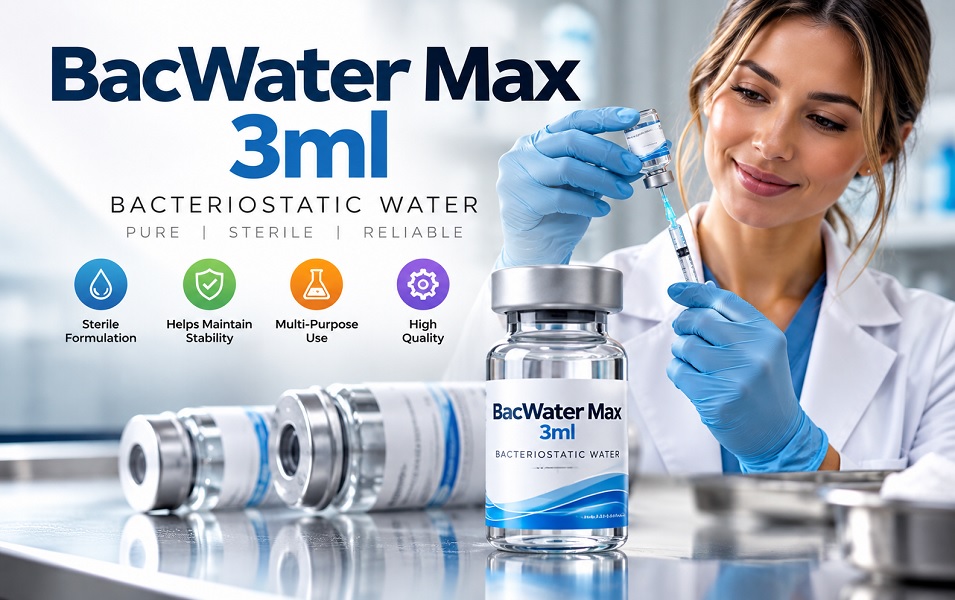
BacWater Max 3ml: Precision Bacteriostatic Water for Labs
Why Researchers Choose Compact Diluent Vials
Small-volume reagents matter more than most people realize when a lab bench is short on space and every milliliter counts. BacWater Max 3ml was built around that exact problem, giving researchers a compact, sterile diluent option that avoids the waste of larger vials sitting half-used on a shelf. Labs running frequent small-batch reconstitutions often find that oversized containers lead to inconsistent tracking and unnecessary spoilage risk.
A 3ml format also simplifies inventory control for facilities juggling multiple active projects at once. Technicians can assign a single vial to a specific compound or protocol without cross-contamination concerns tied to shared larger stock. This kind of granularity supports cleaner documentation trails, which matters when research teams need to demonstrate consistent handling practices across audits or peer review.
The Role of Benzyl Alcohol in Formulation
Every bacteriostatic solution relies on a small but critical additive to stay usable across repeated draws instead of degrading after a single access. The formulation includes 0.9% benzyl alcohol, a preservative concentration that has become the accepted laboratory standard for multi-use diluents. This addition doesn’t sterilize the solution outright; instead, it suppresses microbial proliferation in the remaining liquid each time the vial is punctured.
That distinction is why bacteriostatic water differs meaningfully from plain sterile water in day-to-day lab work. Sterile water without a preservative is generally treated as single-use once opened, since nothing in the solution resists contamination after the seal is broken. A benzyl-alcohol-based formula extends the practical window during which a vial remains chemically stable and microbiologically controlled for sequential access.
Sterility Standards Behind Every Vial
Sterility isn’t a marketing claim in laboratory contexts; it’s a manufacturing requirement tied to filtration, sealing, and quality-control checks performed before a vial ever reaches a bench. Production batches are filtered to remove particulates and processed under controlled conditions designed to minimize bioburden before sealing. Each sealed vial is then expected to hold that sterile state until the closure is first penetrated by a needle or syringe.
Researchers working with sensitive lyophilized compounds depend heavily on this baseline purity, since any contamination introduced at the diluent stage can compromise an entire experimental batch. Consistent sterility processing also reduces variability between vials, which matters when a protocol is repeated across multiple sessions or handed off between lab members. Reliable batch-to-batch consistency is one of the underlying reasons researchers standardize on a single trusted diluent source rather than switching suppliers frequently.
Matching Vial Size to Research Scale
Choosing a diluent volume isn’t just about convenience; it directly affects how efficiently a lab manages its reagent budget and waste stream. Smaller-scale experiments, single-compound trials, and preliminary testing phases often don’t require the larger multi-dose vials common in bigger production settings. A compact 3ml option fits naturally into workflows where researchers are reconstituting modest quantities of lyophilized material for short-term or exploratory work.
This sizing also reduces the risk of over-ordering diluent that ends up expiring unused on a shelf. Labs operating on tighter budgets or smaller footprints benefit from matching diluent volume to actual consumption patterns rather than defaulting to bulk packaging. Over time, this kind of right-sizing contributes to better reagent turnover and less accumulated inventory waste across a facility.
Multi-Draw Design for Sequential Access
Protocols that span days or weeks need a diluent capable of tolerating repeated needle punctures without losing its protective properties between uses. A multi-draw vial design allows a single unit to be accessed multiple times across a research timeline, provided the benzyl alcohol preservative remains effective throughout that period. This is particularly relevant for longitudinal studies where the same reconstituted solution is sampled at different experimental time points.
Handling discipline still plays a major role in maintaining that integrity across draws. Aseptic technique during each access, proper needle disposal, and consistent storage between uses all contribute to keeping a multi-draw vial reliable from the first puncture to the last. Labs that document access frequency alongside storage conditions tend to get more predictable results when tracking solution stability over an extended reconstitution period.
Storage Conditions That Preserve Integrity
Even a well-formulated bacteriostatic solution can lose reliability if it’s stored under the wrong conditions for an extended period. Controlled room temperature, generally in the range most labs already maintain for general reagent storage, is typically sufficient for maintaining vial stability before and after opening. Exposure to direct sunlight or significant temperature swings can accelerate degradation of both the water solution and the benzyl alcohol preservative itself.
Facilities that store diluent vials in clean, dry environments away from heat sources tend to see fewer inconsistencies in downstream reconstitution results. It’s also worth noting that improper storage doesn’t always produce visible signs of spoilage, which is why many labs adopt fixed shelf-life windows rather than relying purely on visual inspection. Building storage protocols around manufacturer guidance rather than assumption helps prevent subtle degradation from affecting sensitive research outcomes.
Supporting Reconstitution of Lyophilized Compounds
Freeze-dried research compounds are stable in powder form but require a compatible liquid vehicle before they can be used in any experimental protocol. BacWater Max 3ml is formulated specifically to support that reconstitution step, providing a consistent aqueous base that dissolves lyophilized material without introducing incompatible additives. The goal is a clean, predictable solution that behaves the same way across repeated preparations.
Consistency at this stage has downstream effects on data quality. If a diluent varies in purity or preservative concentration between batches, it can introduce variability into experimental results that has nothing to do with the actual compound being studied. Standardizing on a single, well-documented diluent source helps researchers isolate variables more effectively, which is a foundational principle in controlled laboratory work regardless of the specific compound being reconstituted.
Documentation and Traceability in Lab Settings
Serious research environments increasingly emphasize traceability, not just for the compounds under study but for every reagent that touches an experiment. Batch numbers, expiration dates, and storage logs tied to a diluent vial contribute to a fuller audit trail when results need to be reviewed or reproduced later. This level of documentation has become more standard as research groups face greater scrutiny around reproducibility.
Labs that maintain organized records around diluent usage, including which vial was used for which reconstitution and when, are better positioned to troubleshoot unexpected results. If an experiment produces anomalous data, having a clear paper trail on the diluent side rules out one variable quickly. This kind of disciplined record-keeping is a small operational habit that pays off significantly during peer review or internal quality checks.
Cost Efficiency Across Research Budgets
Budget considerations shape almost every purchasing decision in a research setting, and diluent costs, while individually small, add up across ongoing projects. Bulk pack options for compact vials allow labs to secure better per-unit pricing without committing to oversized containers that risk going unused. This balance between bulk savings and appropriately sized packaging is particularly relevant for smaller labs or independent researchers managing tighter budgets.
Choosing the right pack size also reduces long-term waste, since unopened vials generally maintain a longer shelf life than partially used larger containers. Researchers comparing suppliers often weigh not just sticker price but total cost per usable milliliter across a project’s duration. A well-matched combination of vial size and pack quantity tends to deliver better long-term value than simply buying the largest available option by default.
Choosing a Reliable Supplier for Lab Diluents
Not all suppliers maintain the same manufacturing standards, and that variability can matter significantly when a diluent is going into sensitive reconstitution work. Researchers evaluating a new source typically look at documented sterility processes, benzyl alcohol concentration accuracy, and consistency across production batches before making a switch. Supplier transparency around these details tends to correlate with more reliable results at the bench.
BacWater Max 3ml fits into this evaluation process as an option positioned specifically for research and laboratory applications rather than clinical or human use. Labs sourcing diluent for ongoing peptide or compound research generally prioritize suppliers who clearly label intended use, provide consistent packaging, and offer straightforward access to compact formats like the 3ml vial. That clarity around intended purpose helps research teams stay aligned with proper laboratory protocols while keeping their reconstitution workflows efficient and well documented.
